
 Posted by
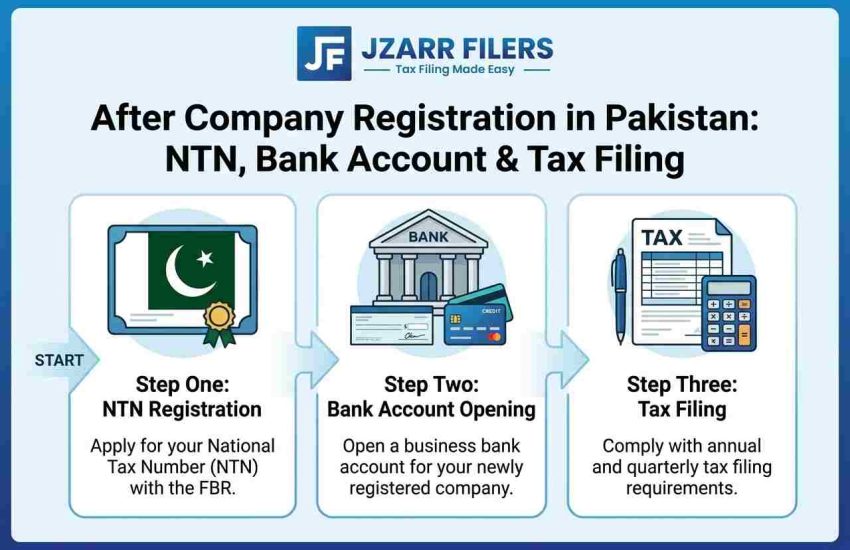
 Congratulations. Your company is incorporated. But the Certificate of Incorporation is just the starting line. What you do in the first few weeks after company registration in Pakistan determines whether your company can actually operate, transact, and stay compliant. This guide covers every step you need to take next.
Post-Incorporation Checklist (At a Glance)
| # | Step | Why it matters |
| 1 | Register company NTN with FBR | Required to file tax returns, issue invoices, and deal with FBR |
| 2 | Open a corporate bank account | Required for all business transactions – personal accounts won’t do |
| 3 | Register for Sales Tax (STRN) | Required if your business supplies taxable goods or services |
| 4 | Notify registered office to SECP | Must be done within 30 days of incorporation |
| 5 | Set up corporate tax filing | Annual income tax return + SECP annual return are mandatory |
| 6 | Protect your brand | Register your company name as a trademark before someone else does |
Step 1 – Register Your Company’s NTN with FBR
Your company needs its own NTN (National Tax Number) separate from your personal NTN. This is how FBR identifies your company for tax purposes. Without a company NTN, you can’t file corporate tax returns, register for sales tax, or issue proper invoices.
Company NTN registration is done on the FBR IRIS portal using your Certificate of Incorporation, MOA/AOA, Form 29, directors’ CNICs, and the company’s bank account (once opened). For the process, see our NTN registration guide, the company-registration path.
Timing: register the NTN as soon as possible after incorporation. You’ll need it to open the bank account (some banks ask for it), and you’ll need the bank account to complete the NTN (FBR asks for a company bank IBAN). In practice, many founders run both in parallel.
Step 2 – Open a Corporate Bank Account
A company bank account is essential, you cannot run business transactions through your personal account. Banks will ask for:
- Certificate of Incorporation
- Memorandum & Articles of Association (MOA/AOA)
- Form 29 (directors and officers)
- Board resolution authorising account opening and signatories
- CNICs of all directors and authorised signatories
- Company NTN certificate (or proof of NTN application)
- Proof of registered office address
Different banks have slightly different requirements and processing times. Approach your chosen bank early corporate account opening can take longer than you expect.
Step 3 – Register for Sales Tax / STRN (If Applicable)
If your company supplies taxable goods or services, you must register for a Sales Tax Registration Number (STRN) with FBR.
This is a separate registration from income tax. Not every company needs STRN, but if your business involves manufacturing, importing, or providing certain services (IT, telecom, restaurants, etc.), it’s likely required.
Step 4 – Notify Your Registered Office to SECP
Within 30 days of incorporation, you must notify SECP of your definitive registered office address (Form 21). If you used a correspondence address during incorporation, now is the time to confirm the permanent one. Missing this deadline can attract a penalty.
Step 5 – Set Up Corporate Tax Filing
Your company is now a separate taxpayer. It must file its own corporate income tax return with FBR every year, covering the company’s income, expenses, and tax. The company is taxed at the corporate tax rate (not the salaried/individual slabs).
In addition, SECP requires companies to file annual returns confirming directors, shareholders, and financial statements. Missing either filing attracts penalties and can lead to the company being struck off the register.
For the individual filing process (which your directors still need to do for their personal income), see our income tax return guide.
Step 6 – Protect Your Brand (Trademark)
Your SECP company name is protected from duplication at SECP, but it is not protected as a trademark. Anyone could register a similar brand name for their goods or services unless you trademark it.
Don’t wait until a copycat forces your hand. See our trademark registration guide.
Ongoing Compliance: What’s Due Every Year
- Corporate income tax return (FBR): filed annually on IRIS
- SECP annual return: filed annually confirming directors, shareholders, and financials
- Sales tax returns (FBR): filed monthly if you’re STRN-registered
- Withholding tax statements: if your company deducts tax from suppliers or employees
- Director changes / share transfers: notify SECP within the prescribed period
Missing any of these can result in penalties, notices, and in extreme cases, the company being struck off SECP’s register.
Common Post-Incorporation Mistakes
- Delaying NTN registration, you can’t invoice, file tax, or complete the bank account without it.
- Running business through a personal bank account instead of a corporate one.
- Forgetting the 30-day registered-office notification to SECP.
- Not filing the first year’s corporate return (even if turnover is zero a nil return is still required).
- Assuming the company name is trademark-protected (it isn’t).
Frequently Asked Questions
Q: What is the first thing to do after company registration?
Register your company’s NTN with FBR and open a corporate bank account. These two steps enable your company to transact and comply with tax law.
Q: Does a company need its own NTN?
Yes. A company has a separate NTN from its directors. Without it, the company can’t file returns, register for sales tax, or issue proper invoices.
Q: What documents do I need for a corporate bank account?
Certificate of Incorporation, MOA/AOA, Form 29, board resolution, directors’ CNICs, company NTN, and proof of registered office. Requirements vary slightly by bank.
Q: Do I need to file a return even if revenue is zero?
Yes. A nil return is still required. Not filing even with zero income attracts penalties and can lead to the company being struck off.
Q: Is SECP annual return the same as the tax return?
No. The SECP annual return confirms directors, shareholders, and financials with SECP. The income tax return is filed separately with FBR. Both are mandatory.
Q: Does my company name protect my brand?
No. SECP registration protects the company name from duplication at SECP only. To legally protect your brand for goods and services, register it as a trademark with IPO-Pakistan.
We’ll Handle Everything After Incorporation
The post-incorporation steps are where most new companies stumble NTN delays, bank rejections, missed SECP filings. JZARR Filers (Karachi) handles your company NTN, bank-account documentation, sales-tax registration, corporate tax filing, and trademark protection, so your company is fully operational from day one.