
 Posted by
 Picking the right trademark class is one of the most important and most misunderstood steps in registering your brand. This guide explains trademark classes in Pakistan, lists all 45 classes under the NICE Classification, and shows you how to choose the right one for your business.
What Are Trademark Classes?
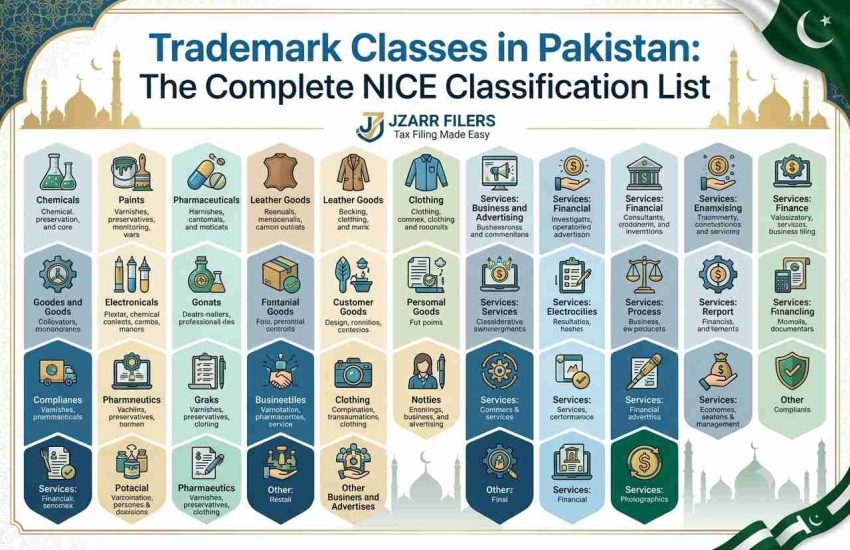
Trademarks are registered by class a category that groups similar goods or services. Pakistan follows the international NICE Classification (Nice Classification of Goods and Services), which has 45 classes: Classes 1–34 cover goods, and Classes 35–45 cover services.
Your protection applies only to the class(es) you register in. So if you register a clothing brand in Class 25 (clothing), someone else could still use a similar name for, say, a restaurant in Class 43 unless you register there too.
Pakistan Uses Single-Class Filing
Key rule: Pakistan uses single-class filing. Each application (Form TM-1) covers ONE class. If your brand spans multiple classes, you file and pay for a separate application per class. This is the biggest driver of total cost.
See how this affects your budget in our trademark registration fees guide.
Trademark Class List – Goods (Classes 1–34)
| Class | What it broadly covers |
| Class 1 | Chemicals for industry, science and agriculture |
| Class 2 | Paints, varnishes, colorants, inks |
| Class 3 | Cosmetics, perfumery, soaps, cleaning preparations |
| Class 4 | Industrial oils, greases, lubricants, fuels, candles |
| Class 5 | Pharmaceuticals, medical/veterinary preparations, supplements |
| Class 6 | Common metals and goods made of metal |
| Class 7 | Machines, machine tools and motors (non-vehicle) |
| Class 8 | Hand tools and implements (hand-operated) |
| Class 9 | Computers, software, electronics, scientific apparatus |
| Class 10 | Medical, surgical and dental apparatus and instruments |
| Class 11 | Lighting, heating, cooking, refrigerating, water-supply apparatus |
| Class 12 | Vehicles and apparatus for transport by land, air or water |
| Class 13 | Firearms, ammunition, explosives, fireworks |
| Class 14 | Precious metals, jewelry, watches |
| Class 15 | Musical instruments |
| Class 16 | Paper, printed matter, stationery, packaging |
| Class 17 | Rubber, plastics and insulating materials (semi-finished) |
| Class 18 | Leather goods, bags, luggage, umbrellas |
| Class 19 | Non-metallic building materials |
| Class 20 | Furniture, mirrors, picture frames |
| Class 21 | Household and kitchen utensils, glassware, crockery |
| Class 22 | Ropes, nets, tents, sacks, raw fibrous materials |
| Class 23 | Yarns and threads for textile use |
| Class 24 | Textiles, fabrics, household linen |
| Class 25 | Clothing, footwear, headgear |
| Class 26 | Lace, ribbons, buttons, artificial flowers (haberdashery) |
| Class 27 | Carpets, rugs, mats, floor and wall coverings |
| Class 28 | Games, toys, sporting goods |
| Class 29 | Meat, fish, poultry, dairy, processed/preserved foods, oils |
| Class 30 | Coffee, tea, flour, bread, pastry, confectionery, spices |
| Class 31 | Fresh fruits and vegetables, seeds, live animals, agriculture |
| Class 32 | Beers, mineral water, soft drinks, juices |
| Class 33 | Alcoholic beverages (except beer), wines, spirits |
| Class 34 | Tobacco, smokers’ articles, matches |
Trademark Class List – Services (Classes 35–45)
| Class | What it broadly covers |
| Class 35 | Advertising, business management, retail/wholesale services |
| Class 36 | Insurance, banking, financial and real estate services |
| Class 37 | Construction, installation, repair and maintenance |
| Class 38 | Telecommunications |
| Class 39 | Transport, packaging, storage, travel arrangement |
| Class 40 | Treatment and processing of materials, manufacturing services |
| Class 41 | Education, training, entertainment, sporting and cultural activities |
| Class 42 | IT, software development, scientific and technology services, design |
| Class 43 | Restaurants, catering, hotels and temporary accommodation |
| Class 44 | Medical, veterinary, beauty and agriculture services |
| Class 45 | Legal, security and personal/social services |
Note: these are simplified summaries. Each class has official headings and explanatory notes that decide exactly what falls inside it, always check the official class scope before filing.
Which Trademark Class Do You Need? (Common Examples)
Here’s the class most Pakistani businesses look for:
- Clothing / apparel brand: Class 25
- Restaurant / café: Class 43 (and Class 29/30 if you sell packaged food)
- Software / app / IT company: Class 9 (software as a product) and/or Class 42 (development, SaaS)
- Cosmetics / skincare: Class 3
- Online store / retail / e-commerce: Class 35 (retail services)
- Packaged food products: Class 29 or 30 (depending on the food)
- Beverages / soft drinks: Class 32
- Education / academy / training: Class 41
- Salon / clinic / beauty services: Class 44
- Marketing / consultancy agency: Class 35
What If My Brand Needs Multiple Classes?
Many brands genuinely span several classes. A fashion label might need Class 25 (clothing) and Class 35 (retail); an IT startup might need Class 9 (software) and Class 42 (development).
In Pakistan, you file a separate TM-1 for each more classes mean broader protection but higher cost. Register the classes that matter most to your core business first, then expand.
Common Classification Mistakes
- Registering the wrong class – the #1 cause of objections and wasted fees.
- Registering too narrowly – leaving a gap a competitor can exploit.
- Confusing goods and services – e.g. a software product (Class 9) vs software development services (Class 42).
- Ignoring retail (Class 35) – many product brands that also sell online overlook it.
Frequently Asked Questions
Q: How many trademark classes are there in Pakistan?
45 classes under the international NICE Classification Classes 1 to 34 for goods and Classes 35 to 45 for services.
Q: Can I register my trademark in more than one class?
Yes, but Pakistan uses single-class filing, so you file a separate TM-1 application (and pay separately) for each class.
Q: Which class is clothing / a restaurant / software?
Clothing is Class 25, restaurants and cafes are Class 43, and software falls in Class 9 (product) and/or Class 42 (development services).
Q: What happens if I choose the wrong class?
Wrong classification is the most common cause of objections and delays, and can leave your brand unprotected. It’s worth getting it right (or getting help) the first time.
Q: Does registering in one class protect my brand everywhere?
No. Protection applies only to the class(es) you register. If your brand operates across categories, you should register in each relevant class.
Q: How do I know exactly what a class covers?
Each class has official headings and explanatory notes. Check the official class scope (IPO-Pakistan / WIPO) or consult a professional before filing.
Not Sure Which Class You Need? We’ll Classify It Right
Classification errors cost time, money, and protection. JZARR Filers (Karachi) identifies the exact classes your brand needs, runs the search, and files each application correctly, so your trademark actually protects what you sell.
Book your free consultation today and classify your trademark the right way.