
 Posted by
 Becoming a filer in Pakistan is one of the smartest financial decisions you can make and in 2026, it matters more than ever. The government has sharply increased the penalty for late filers, so getting on the Active Taxpayer List (ATL) on time now saves you real money on almost every major transaction.
This guide walks you through exactly how to become a filer in Pakistan in 2026: what a filer is, why it’s worth it, who needs to file, and the complete step-by-step process on the FBR IRIS portal.
What Is a Filer? (And What Is the ATL?)
A filer is a person or business whose name appears on the Active Taxpayer List (ATL), the official list published by the Federal Board of Revenue (FBR). Your name is added to the ATL once you have filed your income tax return for the relevant tax year and it has been accepted.
The ATL is updated regularly by FBR, so after you file, allow a few days for your status to appear. Anyone who has not filed is treated as a non-filer and pays significantly higher tax rates on everyday financial activities.
Important: If your employer deducts tax from your salary every month, that does not automatically make you a filer. You are only a filer once you file a return through IRIS and your name appears on the ATL.
Why Become a Filer? (Filer vs Non-Filer Benefits)
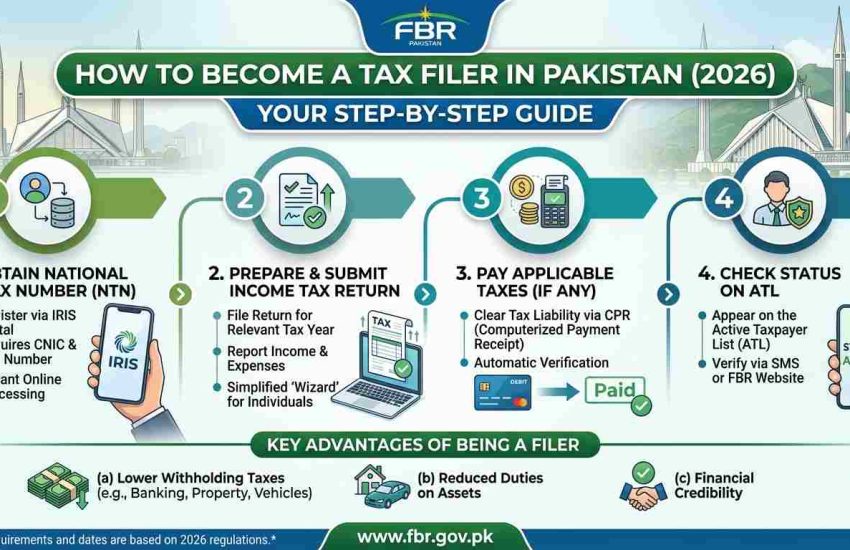
Being on the ATL means you pay lower withholding tax on almost everything, including:
- Banking transactions — lower tax on cash withdrawals and transfers
- Buying or selling property — reduced advance tax under Sections 236C and 236K
- Vehicle purchase and registration — lower advance tax and token tax
- Prize bonds, dividends, and profit on savings — lower deduction rates
Non-filers pay these same taxes at much higher rates often double. On a large property purchase, the difference can run into hundreds of thousands of rupees. In short: filer status saves you money even if your actual tax liability is zero.
New in 2026: The Rs 25,000 Late Surcharge
Here’s the big change you need to know about. Under the Finance Act 2026, the surcharge to get back onto the ATL after missing the deadline has jumped dramatically:
- Individuals: Rs 25,000 (previously Rs 1,000)
- Association of Persons (AOP): Rs 50,000
- Companies: Rs 100,000
This surcharge applies on top of any late-filing penalty and your actual tax due. The lesson is simple: file on time and you pay nothing extra. Miss the deadline, and getting your filer status back becomes expensive.
Who Needs to File a Tax Return in Pakistan?
You are generally required to file an income tax return if any of the following apply to you:
- Your annual income exceeds Rs 600,000
- You own immovable property of 500 sq. yards or more
- You own a motor vehicle with engine capacity of 1000cc or above
- You hold a commercial electricity connection with high annual billing
- You are a salaried employee, business owner, freelancer, landlord, or pensioner with taxable income
If you’re unsure whether you need to file, it’s always safer to check the cost of becoming a filer is minimal compared to the tax you overpay as a non-filer.
How to Become a Filer in Pakistan: Step-by-Step
Step 1 — Register for an NTN on the FBR IRIS Portal
Your National Tax Number (NTN) is your identity in the tax system. To get one:
- Go to the FBR IRIS portal (iris.fbr.gov.pk) and click Registration for Unregistered Person.
- Enter your CNIC, mobile number, and email. FBR will send verification codes.
- Complete your profile — address, employer or business details, and bank account.
- Once submitted, your NTN is generated (for individuals, your CNIC usually serves as your NTN).
Need help getting your NTN quickly and correctly? See our NTN Registration service.
Step 2 — Gather Your Documents
Before filing, keep these ready:
- CNIC
- Salary certificate or payslips (for salaried individuals) showing gross income and tax deducted
- Bank statements for the tax year
- Details of any other income (rent, business, freelancing, dividends)
- Details of major assets (property, vehicles) for your wealth statement
Step 3 — File Your Income Tax Return
- Log in to IRIS with your credentials.
- Open the income tax return form for the relevant tax year (Tax Year 2026 covers 1 July 2025 to 30 June 2026).
- Enter your income, deductions, and taxes already paid.
- Complete the Wealth Statement (Section 116) a summary of your assets and liabilities.
- Reconcile, then submit.
Prefer to have experts handle it end-to-end? Our Income Tax Filing service files an accurate return for you and maximises any refund.
Step 4 — Check Your ATL (Filer) Status
After filing, confirm you’re on the Active Taxpayer List using any of these methods:
- Online: Visit the ATL page on the FBR website and search by CNIC/NTN.
- SMS: Type ATL (space) your 13-digit CNIC and send to 9966.
- Tax Asaan App: Log in and check your status instantly on your phone.
Allow a few days after filing for the list to update.
Step 5 — (Only If You Filed Late) Pay the ATL Surcharge
If you missed the deadline, you can still become a filer by filing your overdue return and paying the ATL surcharge (Rs 25,000 for individuals in 2026) through FBR e-payment on IRIS. Once paid and processed, your name is added back to the ATL.
The 2026 Deadline You Can’t Ignore
For Tax Year 2026, the last date to file your income tax return is 30 September 2026 for individuals. File before this date and you’re automatically on the ATL no surcharge, no penalty. FBR sometimes extends the deadline, but waiting for an extension is risky. File early and avoid the rush (the IRIS portal gets overloaded near the deadline).
Common Mistakes to Avoid
- Assuming salary tax deduction makes you a filer it doesn’t. You must file.
- Leaving the wealth statement incomplete or inconsistent with your income.
- Waiting until the last week portal slowdowns cause missed deadlines.
- Ignoring small side income (freelancing, rent) declare everything.
Frequently Asked Questions
Q: How long does it take to become a filer? Once you file your return correctly, your name typically appears on the ATL within a few days, after the next scheduled update.
Q: I’m a salaried person and tax is already deducted. Do I still need to file? Yes. Tax deduction at source does not make you a filer. You must file a return through IRIS to appear on the ATL.
Q: What is the ATL surcharge in 2026? For late filers in 2026, the surcharge to be included on the ATL is Rs 25,000 for individuals, Rs 50,000 for AOPs, and Rs 100,000 for companies in addition to any penalty and tax due.
Q: What is the last date to file the Tax Year 2026 return? For individuals, the deadline is 30 September 2026. Filing on time keeps you on the ATL with no surcharge.
Q: Can overseas Pakistanis become filers? Yes. Overseas Pakistanis with taxable income or assets in Pakistan can and often should file to enjoy filer benefits on property and investments.
Become a Filer the Easy Way with JZARR Filers
Filing correctly the first time saves you from penalties, notices, and overpaid tax. At JZARR Filers (Karachi), we handle your NTN registration, income tax return, and ATL status from start to finish fast, affordable, and fully FBR-compliant.
Beat the 30 September 2026 deadline. Book your free consultation today and become a filer without the stress.
Disclaimer: This article is for general information only and reflects tax rules as of July 2026. Tax laws change with each Finance Act. Please confirm current deadlines, rates, and surcharges on the official FBR website (fbr.gov.pk) or consult a tax professional before acting.