
 Posted by
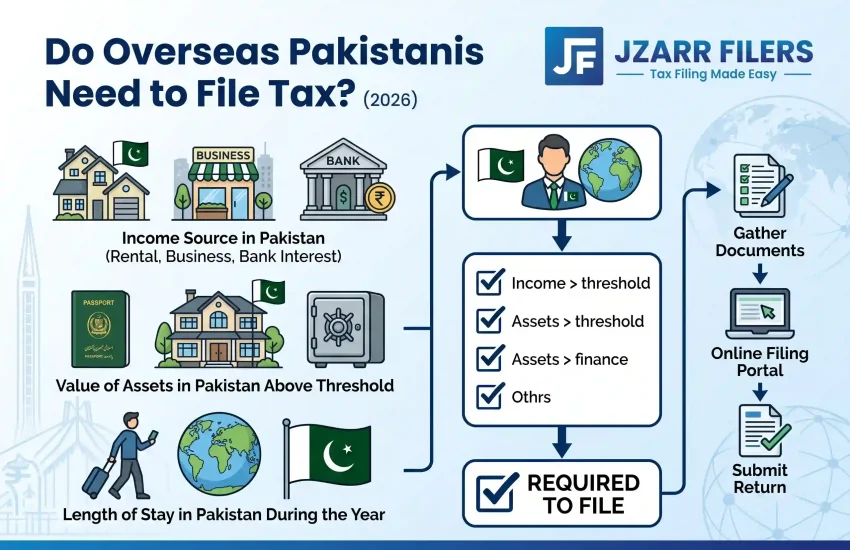
 If you’re an overseas Pakistani wondering whether you still need to file a tax return for overseas Pakistani income with FBR, the short answer is: probably yes and it’s almost certainly in your interest even if you don’t technically have to.
Quick answer: If you live abroad and spend fewer than 183 days in Pakistan during the tax year (July 1 – June 30), you are a non-resident. Your foreign salary and overseas income are NOT taxable in Pakistan. Only your Pakistan-source income (rent, bank profit, dividends, capital gains) is taxable. Even if you owe zero tax, filing puts you on the Active Taxpayer List (ATL) and saves you massive withholding tax on property, banking, and vehicle transactions.
This guide covers everything an overseas Pakistani filer needs to know: the 183-day rule, what income is taxable, the NICOP/POC filer facility, how to file from abroad on FBR IRIS, and why filer status saves you lakhs on property alone.
Who Is Considered a Non-Resident Pakistani?
Under Section 82 of the Income Tax Ordinance, 2001, the primary test is simple: if you are physically present in Pakistan for fewer than 183 days during a tax year (1 July to 30 June), you are generally treated as a non-resident for tax purposes.
The days do not need to be consecutive. Every trip home counts partial days included. FBR’s upgraded data systems cross-reference your passport entry and exit stamps, so maintaining a personal travel log is strongly recommended.
The Deemed-Resident Trap (Section 82(d))
There is a lesser-known provision that catches many overseas Pakistanis. Under Section 82, a Pakistani citizen can be treated as a deemed resident if:
- They are not present in any other single country for more than 182 days during the tax year, OR
- They are not a tax resident of any other country.
This can trap people who move between countries frequently (e.g. between Dubai and the UK) or live in a zero-tax jurisdiction (e.g. UAE) without formal tax residency documentation. If FBR classifies you as a resident, your worldwide income becomes taxable in Pakistan.
Tip: Get a tax residency certificate (TRC) from your host country. If you live in the UAE or a Gulf state, the local authorities now issue TRCs. This is your strongest defence against deemed-resident classification by FBR.
What Income Is Taxable for Non-Resident Overseas Pakistanis?
As a non resident pakistani tax payer, only your Pakistan-source income is taxable. Your foreign salary, overseas business income, and remittances sent through banking channels are not taxable in Pakistan.
| Income Type | Taxable? | Notes |
| Foreign salary / wages | No | Exempt for non-residents |
| Remittances via banking channels | No | Home remittance is tax-free |
| Rental income from Pakistan property | Yes | Taxed at applicable slab rates |
| Bank profit / savings (PKR accounts) | Yes* | Clause 79 exemption may apply for NICOP/POC holders |
| Dividends from Pakistani companies | Yes | Subject to withholding at source |
| Capital gains on Pakistan property | Yes | Section 37 CGT rates apply |
| Capital gains on Pakistan stocks | Yes | Taxed per holding period |
| Business income from Pakistan | Yes | If permanent establishment exists |
| Foreign currency account profit | No* | Clause 78 exempt under SBP scheme |
Key point: Declaring your foreign income on your return does not mean you pay tax on it. It creates a transparent record and helps reconcile your wealth statement. Many overseas Pakistanis owe zero or minimal tax.
Do You NEED to File or SHOULD You File?
When Filing Is Legally Required
- You earn any Pakistan-source income (rent, dividends, bank profit, capital gains)
- You already hold an NTN (your CNIC/NICOP is effectively your NTN)
- FBR has issued you a notice requiring a return
When Filing Is Optional But Strongly Recommended
If your only income is from abroad and you have zero Pakistan-source income, filing is technically optional. But most overseas Pakistanis file anyway, and here is why:
- Property purchases (236K): a filer pays 1.25% advance tax. A non-filer pays 10.5% to 18.5%. On a Rs 50 million plot, that is Rs 625,000 vs Rs 5,250,000 a difference of Rs 46.25 lakh on ONE transaction.
- Property sales (236C): a filer pays 2.75%. A non-filer pays 11.5%.
- Banking: filers pay roughly half the withholding tax on cash withdrawals, bank transfers, and profit on deposits.
- Vehicle registration: filer rates on token tax and vehicle purchase are significantly lower.
- Refund claims: if withholding tax has been deducted at source (bank profit, dividends), you can only claim a refund by filing a return.
- Clean record: avoids FBR notices, protects against future audits, and makes loan/visa documentation easier.
Filer vs Non-Filer: Withholding Tax Comparison (2026–27)
These are the rates that affect overseas Pakistanis the most. The numbers speak for themselves.
| Transaction | Filer Rate | Non-Filer Rate | Difference on Rs 50M |
| Property purchase (236K) | 1.25% | 10.5–18.5% | Rs 46.25 lakh+ |
| Property sale (236C) | 2.75% | 11.5% | Rs 43.75 lakh |
| Bank profit withholding | 20% | 40% | Double the deduction |
| Cash withdrawal (>Rs 50k) | 0.6% | 1.2% | Double the deduction |
Real example: An overseas Pakistani buying a Rs 1 crore (Rs 10 million) plot in DHA Lahore pays Rs 125,000 in 236K as a filer. As a non-filer, they would pay Rs 1,050,000, that is Rs 925,000 saved by simply filing a tax return that may show zero tax liability.
The NICOP / POC Filer-Rate Facility
FBR provides a special route for non-resident overseas Pakistanis holding a NICOP or Pakistan Origin Card (POC). Even if you are not on the Active Taxpayer List, you can claim filer rates on property transactions (236C and 236K) through FBR’s dedicated “Overseas Pakistanis” portal process.
How It Works
- At the time of property transfer, the registrar or housing society selects the “Overseas Pakistanis” option on FBR’s web portal.
- Your NICOP/POC number is entered, and the system auto-populates your data.
- Scanned copies of your NICOP/POC and passport stamps (proving non-resident status) are uploaded.
- The case is routed to the Commissioner Inland Revenue for verification.
- After approval, filer rates apply to your transaction.
Important: while this facility exists, filing your return is still the cleaner long-term solution. It puts you on the ATL permanently (renewed each year when you file), lets you claim refunds, and avoids the verification delay at transfer time.
How to File Your Tax Return from Abroad (Step-by-Step)
The entire process is online through the FBR IRIS portal. You do not need to visit Pakistan. See our full guide: how to file income tax return in Pakistan.
- Register on IRIS: go to iris.fbr.gov.pk. Click “Registration” and enter your 13-digit CNIC or NICOP. Your CNIC/NICOP is your NTN individuals do not get a separate NTN number. Complete the profile with an active email and phone number (FBR sends OTPs to these). See NTN registration guide.
- Log in: use your CNIC/NICOP and the password you created. Navigate to “Declaration” → “Income Tax Return” → select the relevant tax year.
- Set residency status as Non-Resident: this is the most critical step. If you accidentally select “Resident”, your foreign income becomes taxable an entirely avoidable disaster.
- Declare Pakistan-source income: report any rental income, bank profit, dividends, or capital gains earned in Pakistan. If you have none, this section stays at zero.
- Declare foreign income (for record): under the foreign income section, declare your overseas earnings. This does NOT make them taxable, it creates transparency and helps reconcile your wealth statement.
- File wealth statement (Section 116): declare your assets (property, vehicles, bank balances both in Pakistan and abroad) and liabilities. See wealth statement guide.
- Submit and verify: review everything, submit, and download the acknowledgement. Your name appears on the ATL shortly after.
Deadline: 30 September each year (for the tax year ending 30 June). The return due by 30 September 2026 covers the period 1 July 2025 to 30 June 2026 (Tax Year 2026).
Documents You Need
- CNIC or NICOP (this is your NTN)
- Passport with entry/exit stamps (to prove days spent in Pakistan)
- Bank statements Pakistan accounts (savings, current, Roshan Digital Account)
- Rental agreements and tenant details (if you own property in Pakistan)
- Dividend certificates or brokerage statements (if you hold Pakistani stocks)
- Foreign salary slips or employment contract (for wealth statement reconciliation)
- Foreign tax residency certificate (TRC) especially important for Gulf countries
- Last year’s wealth statement (for reconciliation)
Returning to Pakistan? Know Section 51
If you are planning to move back to Pakistan permanently, Section 51 of the Income Tax Ordinance provides a valuable two-year exemption:
If you were a non-resident for the four tax years before your return, your foreign-source income is exempt from Pakistani tax in the year you become a resident AND the following tax year. This gives you a two-year window to reintegrate without tax pressure on your overseas savings.
Planning tip: time your return carefully. If you move back in May 2027 (near the end of Tax Year 2027), you get the exemption for TY 2027 and TY 2028 nearly two full years of protection.
Roshan Digital Account (RDA) and Tax
The State Bank of Pakistan’s Roshan Digital Account is specifically designed for overseas Pakistanis. Key tax points:
- Funds sent through RDA are fully documented and traceable, this protects your filer status and strengthens your wealth statement.
- Property purchased through RDA enjoys smooth FBR processing and documented proof of source.
- Always use banking channels (RDA or other non-resident accounts) for remittances and property purchases. Cash or undocumented transfers can strip your filer benefits and treat you as a non-filer.
Common Mistakes Overseas Pakistanis Make
- Selecting “Resident” on IRIS: this single mistake exposes your worldwide income to Pakistani tax. Always select “Non-Resident”.
- Not counting travel days: multiple short visits to Pakistan add up. If you cross 183 days, you become a resident for that tax year. Keep a log.
- Ignoring the wealth statement: the return alone is not enough you must also file a wealth statement (Section 116). Gaps compound over time and become harder to explain.
- Buying property as a non-filer: even with the NICOP facility, filing a return is cheaper and cleaner in the long run. The withholding tax difference is enormous.
- Not keeping a foreign TRC: without a tax residency certificate from your host country, FBR may argue you are a deemed resident of Pakistan under Section 82.
- Using undocumented channels: hundi, cash purchases, or payments through third parties can disqualify your filer benefits and invite FBR scrutiny.
Double Taxation Agreements (DTAs)
Pakistan has signed DTAs with over 65 countries, including the UK, UAE, Saudi Arabia, USA, Canada, Germany, and most Gulf states. If you are a resident and your foreign income has already been taxed in another country, you can claim a Foreign Tax Credit (Section 103) to avoid paying tax twice on the same income.
For most overseas Pakistanis who are non-residents, DTAs are less relevant because foreign income is already exempt. DTAs become important when you return to Pakistan and your residency status changes.
Frequently Asked Questions
Q: Is my foreign salary taxable in Pakistan?
No, if you are a non-resident (fewer than 183 days in Pakistan), your foreign salary is not taxable. Remittances through banking channels are also exempt.
Q: Do I need a separate NTN number?
No. For individuals, your CNIC or NICOP is your NTN. You register on IRIS using this number — you do not receive a separate NTN.
Q: What if I have no Pakistan income at all?
Filing is technically optional, but strongly recommended. A nil return costs nothing and puts you on the ATL, saving you lakhs in withholding tax on future property and banking transactions.
Q: Can I file my return from outside Pakistan?
Yes. The entire process is online through iris.fbr.gov.pk. You do not need to visit Pakistan or any FBR office.
Q: What happens if I miss the 30 September deadline?
You can still file a late return, but your name may be removed from the ATL until filed. If you need to be added back, you may need to pay an ATL surcharge. Read our guide: how to pay the ATL surcharge.
Q: I live in the UAE, am I safe from deemed-resident status?
Not automatically. The UAE now issues tax residency certificates get one. Without it, FBR could argue you are not a tax resident anywhere and classify you as a deemed resident of Pakistan under Section 82(d), making your worldwide income taxable.
Need Help Filing Your Overseas Pakistani Tax Return?
Navigating FBR as an overseas Pakistani does not have to be stressful. JZARR Filers (Karachi) specialises in income tax filing for overseas Pakistanis, we handle your NTN registration, return filing, wealth statement, and ATL status so you can focus on your life abroad.
Deadline: 30 September 2026. Book your free consultation today.