
 Posted by
 If you’ve ever tried to submit your return on IRIS and hit a wall, chances are it was the wealth statement. This guide explains exactly how to file your wealth statement (Section 116). what goes in it, how wealth reconciliation works, and how to fix the errors that keep your return stuck.
Why this matters: IRIS will NOT let you submit your income tax return until the wealth statement is complete AND reconciled. An unreconciled wealth statement is the #1 reason returns get stuck.
What Is a Wealth Statement?
A wealth statement (Section 116) is a mandatory declaration every individual taxpayer files alongside their income tax return. It’s a snapshot of everything you own (assets) and owe (liabilities) as of 30 June of the tax year, plus your personal expenses during the year.
Think of it as FBR’s way of cross-checking: does your lifestyle and wealth match the income you declared? If your assets grew more than your income can explain, FBR will ask questions.
Who Must File a Wealth Statement?
Every individual filing a return under Section 114 is required to file a wealth statement salaried, business, freelancer, or landlord. There is no exemption based on income level: if you file a return, you file a wealth statement.
What Goes Into the Wealth Statement
Assets (what you own as of 30 June 2026):
- Immovable property (land, house, flat) with address, area, and value
- Vehicles (car, motorcycle) make, model, year, value
- Bank balances (closing balance of every account as of 30 June)
- Cash in hand
- Investments shares, mutual funds, savings certificates, prize bonds
- Business capital / stock-in-trade (for sole proprietors)
- Gold, jewelry, and other valuables (if significant)
- Any other assets of value
Liabilities (what you owe as of 30 June 2026):
- Personal loans, car loans, mortgage
- Credit card outstanding balance
- Business loans or payables
- Any other debts
Personal expenses during the year:
- Household expenses (rent, utilities, groceries, education, medical)
- Vehicle running costs
- Any other significant personal expenditure
How Wealth Reconciliation Works
This is the part that confuses most people. Wealth reconciliation is a simple equation that must balance:
| Item | Amount |
| (A) Net wealth this year (assets − liabilities, 30 June 2026) | e.g. Rs 5,000,000 |
| (B) Net wealth last year (assets − liabilities, 30 June 2025) | e.g. Rs 4,200,000 |
| (C) Change in wealth (A − B) | Rs 800,000 |
| (D) Declared income (from your return) | e.g. Rs 1,800,000 |
| (E) Personal expenses (from your wealth statement) | e.g. Rs 1,000,000 |
| (F) Income minus expenses (D − E) | Rs 800,000 |
| Reconciliation: C must equal F | Rs 800,000 = Rs 800,000 ✔ |
In plain language: the increase in your wealth should equal your income minus what you spent. If it doesn’t match, IRIS blocks submission.
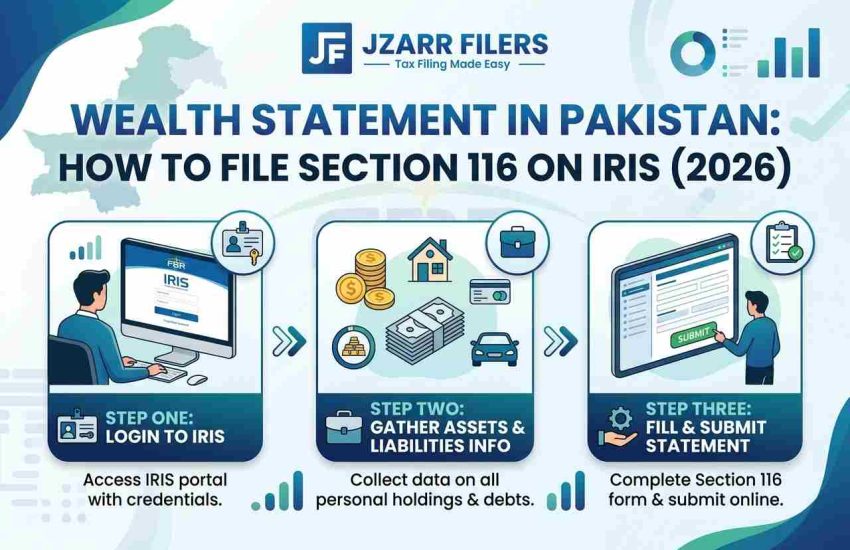
How to File the Wealth Statement on IRIS
- Open your income tax return in IRIS (it’s part of the same form).
- Navigate to the Wealth Statement (Section 116)
- Enter all assets with their values as of 30 June 2026.
- Enter all liabilities as of 30 June 2026.
- Enter your personal expenses for the year.
- Click Calculate / Reconcile IRIS checks whether the change in wealth equals income minus expenses.
- If it reconciles (difference = zero), proceed to submit your return. If not, adjust your figures until the gap is zero.
“My Wealth Statement Won’t Reconcile” – How to Fix It
This is the most common problem. Here’s where to look:
- Missing or understated assets: did you forget a bank account, an investment, or a vehicle? Every asset must be listed.
- Wrong prior-year figures: if this is your first return, your prior-year wealth is zero. If you filed before, the prior-year figures should match last year’s wealth statement exactly IRIS pre-populates them, but verify.
- Understated expenses: household, vehicle, children’s education, medical underestimating these is common and creates a gap.
- Undeclared income: if your wealth grew more than your declared income can explain, you may have income you forgot to declare (rent, freelancing, bank profit).
- Asset valuation: property values should be at cost (purchase price), not current market value. Using market value inflates assets and breaks reconciliation.
See our guide how to register your ntn in Pakistan.
First-Time Filers: Special Considerations
If you’re filing for the first time, your prior-year net wealth is zero, so your entire current-year net wealth must be explained by your declared income minus expenses.
This is where first-timers struggle: they have accumulated assets over many years but are declaring only one year’s income. You may need to show prior savings, gifts, inheritance, or exempt income to bridge the gap. A tax professional can help structure this correctly.
See our complete guide how to become a filer.
Common Mistakes
- Forgetting a bank account or investment (even dormant ones count).
- Using property market value instead of purchase cost.
- Not declaring small income sources (bank profit, rent, freelance).
- Underestimating personal expenses.
- Leaving the prior-year column empty when IRIS doesn’t pre-populate.
- Filing the return without the wealth statement (IRIS won’t let you, but people try).
Check this guide Documents Required for Company Registration in Pakistan.
Another guide Company Registration Cost in Pakistan.
Frequently Asked Questions
Q: What is a wealth statement in Pakistan?
A mandatory declaration (Section 116) filed with your income tax return, listing all your assets, liabilities, and personal expenses. It must reconcile with your declared income.
Q: Why won’t IRIS let me submit my return?
The most common reason is an unreconciled wealth statement, the change in your net wealth doesn’t match your income minus expenses. Fix the gap and it will submit.
Q: Do I list property at market value or purchase price?
At cost (purchase price), not current market value. Using market value overstates your assets and breaks reconciliation.
Q: What if I’m filing for the first time and have existing assets?
Your prior-year wealth is zero, so your current assets must be explained by income, savings, gifts, inheritance, or exempt income. A tax professional can help structure this.
Q: Do I need to list every bank account?
Yes, even dormant or low-balance accounts. FBR can cross-check with banking data, so omitting any account creates risk.
Q: Is the wealth statement part of the return form on IRIS?
Yes. It’s a tab within the same return form. You don’t file it separately, but your return won’t submit until the wealth statement is complete and reconciled.
Stuck on Reconciliation? We’ll Sort It Out
Wealth-statement reconciliation is where most people give up or get it wrong. JZARR Filers (Karachi) prepares your wealth statement, reconciliation, and full return accurately including tricky first-time-filer cases, so your submission goes through clean.
Beat the 30 September 2026 deadline. Book your free consultation today.