
 Posted by
 If you earn a salary, filing your return is simpler than you think and it’s the one thing standing between you and filer benefits (plus any refund you’re owed).
This guide explains the income tax return for salaried persons in Pakistan: who must file, what you need, and how to file your salary tax return on FBR IRIS in 2026.
Do Salaried Persons Need to File a Tax Return?
Yes, if your annual salary exceeds Rs 600,000, you are required to file an income tax return. But even if you earn less, filing is worth it because it makes you a filer on the Active Taxpayer List (ATL) and lets you reclaim any excess tax deducted.
The #1 salaried myth: “My employer already deducts tax, so I don’t need to file.” Not true. Monthly deduction does NOT make you a filer and does NOT put you on the ATL. Only filing your return does.
Why Every Salaried Person Should File
- Become a filer: pay lower withholding tax on property, vehicles, and banking.
- Claim a refund: if too much tax was deducted from your salary, filing is how you get it back.
- Avoid penalties: if you’re required to file and don’t, you risk penalties and the late ATL surcharge.
- Financial record: a filed return + wealth statement is proof of income for visas, loans, and property.
Not sure what filer status saves you? See filer vs non-filer in Pakistan.
What You Need to File (Salaried Checklist)
- CNIC
- Salary certificate from your employer, showing gross salary and total tax deducted for the year
- Bank statements for the tax year (1 July 2025 – 30 June 2026)
- Details of other income rent, profit on savings, freelancing, dividends (if any)
- Assets & liabilities property, vehicles, bank balances, investments (for your wealth statement)
- Any tax already paid e.g. advance tax on your vehicle, mobile, or bank transactions
Understanding Your Salary Tax
Your employer deducts income tax from your salary every month under the salary tax slabs, and deposits it with FBR on your behalf.
When you file your annual return, you reconcile the tax that was deducted against what you actually owe, which may result in a refund (if too much was deducted) or a small balance due.
Salary above Rs 600,000 per year is taxed at progressive slab rates. For the current year’s exact brackets.
See Complete income tax slabs in Pakistan 2025–26 guide.
How to File Your Salary Tax Return (Step-by-Step)
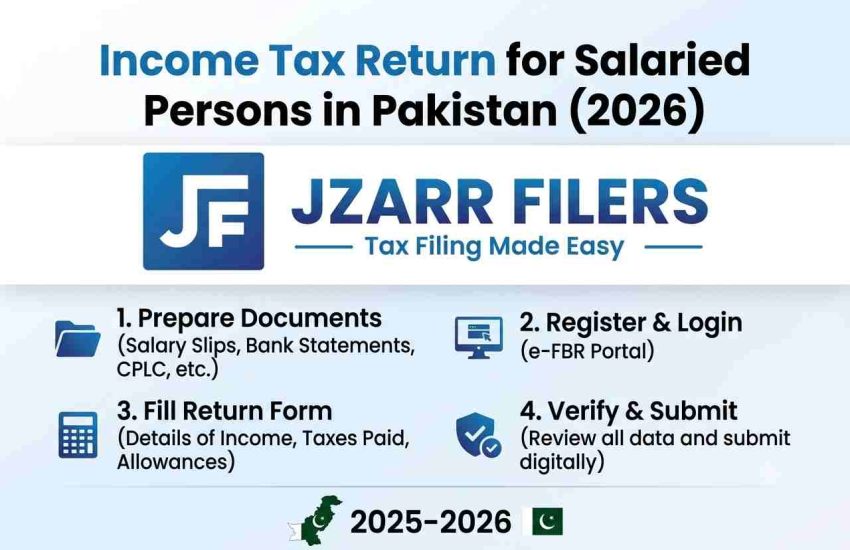
Filing is done free on the FBR IRIS portal (iris.fbr.gov.pk). Here’s the salaried flow:
- Log in to IRIS with your CNIC and password (register first if you’re new your CNIC becomes your NTN).
- Open Declaration → Return of Income u/s 114(1) and select Tax Year 2026.
- Enter your salary income from your salary certificate, and the tax already deducted by your employer.
- Complete the simplified Declaration form 114(I) for salaried persons required for your return to submit.
- Fill your Wealth Statement (Section 116) and make sure it reconciles.
- Click Calculate, review, and Submit. Success = both forms move from Draft to Completed Task.
For a full walkthrough of every IRIS screen, see our pillar guide on how to file your income tax return in Pakistan.
Claiming a Refund (Salaried Filers, Take Note)
Salaried people are often over-deducted for example, tax withheld on your mobile bills, vehicle, or bank transactions on top of salary tax.
When you file, these adjustable taxes are credited against your liability. If the total deducted exceeds what you owe, you can claim the difference as a refund through IRIS. Many salaried filers don’t realise they’re leaving money on the table by not filing.
Don’t Skip the Wealth Statement
As an individual, you must file a Wealth Statement (Section 116) with your return a snapshot of your assets and liabilities that must reconcile with your income. An unreconciled wealth statement is the most common reason a salaried return won’t submit, so complete it carefully.
The 2026 Deadline
For salaried individuals, the last date to file the Tax Year 2026 return is 30 September 2026. File on time to stay on the ATL with no penalty or surcharge and don’t wait for the last day, when IRIS slows down.
Common Mistakes Salaried Filers Make
- Assuming salary deduction = filing (it isn’t).
- Not claiming adjustable taxes and missing a refund.
- Leaving the wealth statement incomplete or unreconciled.
- Forgetting small side income (rent, freelancing, profit on savings).
- Filing late and paying an avoidable surcharge.
Frequently Asked Questions
Q: I’m salaried and tax is deducted from my salary do I still need to file?
Yes. Employer deduction does not make you a filer or put you on the ATL. You must file your return through IRIS to become a filer and to claim any refund.
Q: What income level requires a salaried person to file?
If your annual salary exceeds Rs 600,000, you’re required to file. Below that, filing is still worthwhile to become a filer and reclaim excess tax.
Q: What documents do salaried persons need?
Mainly your CNIC, a salary certificate showing gross salary and tax deducted, bank statements, details of assets/liabilities for the wealth statement, and any other income.
Q: Can I get a tax refund as a salaried person?
Yes. If more tax was deducted than you owed including adjustable taxes on your mobile, vehicle, or banking, you can claim the excess as a refund when you file.
Q: Do salaried persons file a wealth statement?
Yes. Individuals must file a Wealth Statement under Section 116 that reconciles with their income; the return can’t be submitted until it reconciles.
Q: What’s the deadline for salaried returns in 2026?
30 September 2026 for the Tax Year 2026 return. Filing on time keeps you on the ATL with no penalty or surcharge.
File Your Salary Return Stress-Free with JZARR
Filing your salary return right means you become a filer, claim every rupee you’re owed, and avoid penalties. JZARR Filers (Karachi) files accurate salaried returns salary certificate, wealth statement, and refund claim included quickly and affordably.
Beat the 30 September 2026 deadline. Book your free consultation today.